
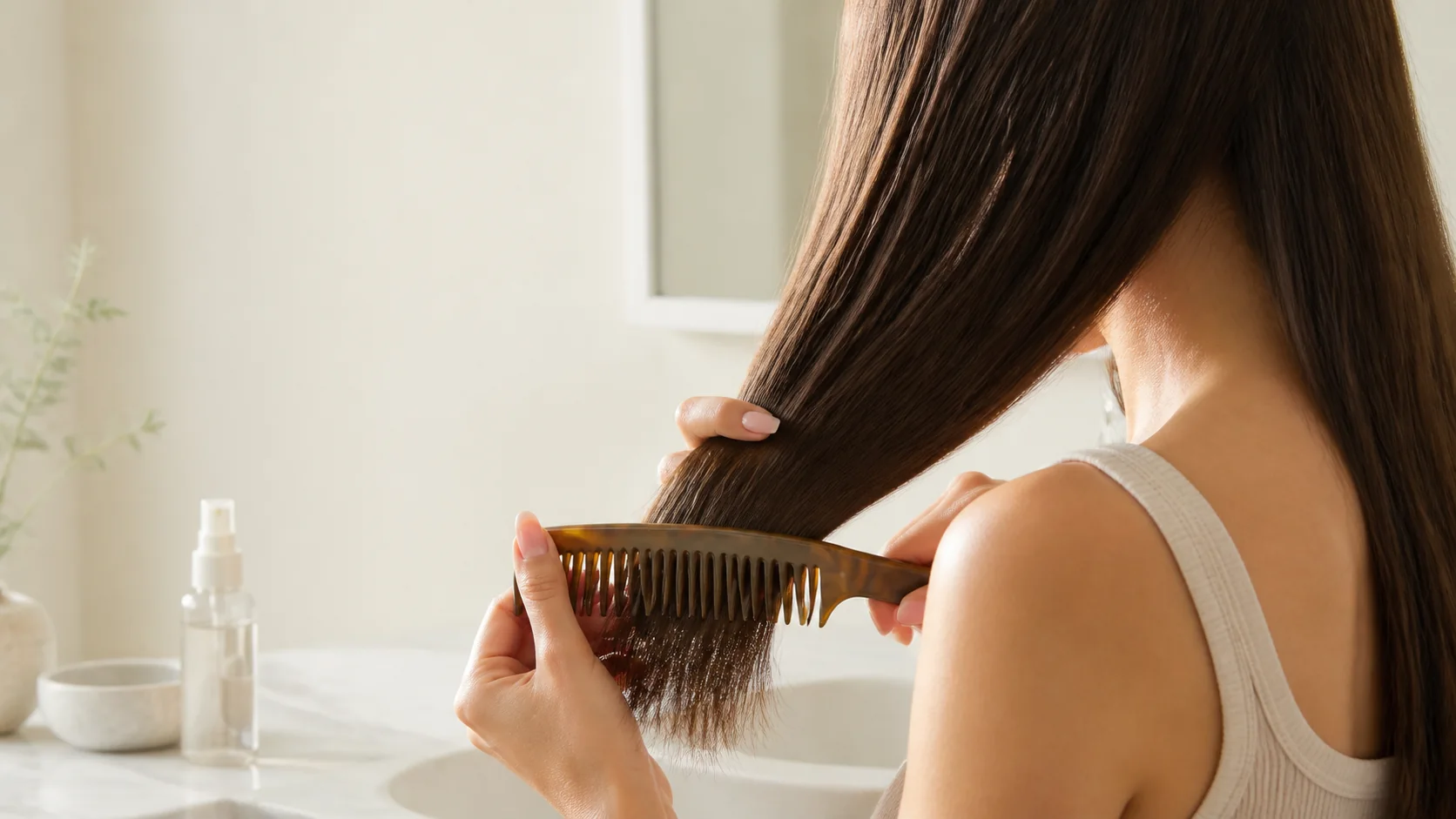
Fine hair can become tangled surprisingly easily. Individual strands are narrow and flexible, so they can wrap around one another, catch on rough ends, and snap when too much force is applied.
The safest way to detangle fine hair is to add a small amount of slip, divide the hair into sections, hold each section above the knot, and work from the ends upward with your fingers or a flexible detangling tool. The correct moisture level depends on your texture. Straight fine hair may be easier to detangle when dry or slightly damp, while fine curly or coily hair usually needs water and conditioner.
This guide explains exactly how to remove tangles while preserving as much hair as possible.
Why Fine Hair Breaks While Detangling
Fine hair describes the diameter of each strand, not the number of hairs on your head. You can have fine strands and still have very dense hair.
A fine strand contains less structural material than a coarse strand. It therefore has less resistance to pulling, bending, heat, and repeated friction. Bleaching, permanent coloring, sun exposure, rough towels, and hot tools can make it even more fragile.
Detangling commonly causes damage when you:
- Start brushing at the roots
- Pull through resistance instead of stopping
- Use a fine-tooth comb on large knots
- Detangle without enough lubrication
- Handle soaking-wet straight hair too aggressively
- Brush curls when they are dry
- Work on sections that are too large
- Use a brush with stiff or damaged bristles
- Detangle after applying sticky styling products
- Rush through knots close to the ends
A few loose hairs in your brush do not automatically mean you caused breakage. Naturally shed hairs have already separated from the follicle and may remain trapped among other strands until wash day. Breakage produces shorter pieces that have snapped somewhere along the hair shaft.
Should Fine Hair Be Detangled Wet or Dry?
There is no single correct answer for every type of fine hair.
Straight fine hair
Straight fine hair is often safest to detangle when it is dry or slightly damp, especially if it is healthy and only mildly tangled. Hair becomes more elastic when wet, and aggressive brushing can overstretch vulnerable strands.
If your straight hair forms stubborn knots after washing, apply a lightweight detangling spray and wait until it is damp rather than dripping wet.
Fine wavy hair
Fine wavy hair can usually be detangled while damp with a lightweight leave-in product. Working on damp hair helps preserve the wave pattern without subjecting completely saturated strands to unnecessary pulling.
Avoid brushing repeatedly after the waves begin to dry. This can separate the pattern, create frizz, and encourage more tangling.
Fine curly or coily hair
Curly and coily strands intersect more frequently and have bends that can become natural points of weakness. These textures are generally easier to detangle while wet and coated with a slippery conditioner.
Dry brushing tightly curled hair can pull apart curl groupings, increase friction, and place too much tension on individual bends. Work slowly in small sections and keep the section wet enough to remain flexible.
Bleached or severely damaged fine hair
Hair that feels gummy, unusually stretchy, rough, or weak requires extra care. Saturating severely compromised hair and then pulling a brush through it may cause snapping.
Use plenty of slip, support the section with one hand, and begin with your fingers. If the hair continues to stretch or break with very light handling, stop and seek advice from an experienced stylist or dermatologist.
What You Need
You do not need a complicated collection of products. A simple detangling kit can include:
- Sectioning clips without sharp edges
- A wide-tooth comb or flexible detangling brush
- A lightweight conditioner or detangling spray
- A spray bottle of water for curly or coily hair
- A smooth microfiber towel or soft cotton T-shirt
- Small scissors reserved for hair, if a true single-strand knot cannot be released
Inspect your tools regularly. Cracked comb teeth, missing bristle tips, and rough seams can catch fine strands. For most people, a flexible brush or seamless wide-tooth comb is a safer starting point than a dense, stiff brush. Your fingers are often the best first tool for large or complicated knots.
How to Detangle Fine Hair Without Breaking It
1. Remove anything that increases friction
Take off necklaces, textured scarves, and clothing with rough collars. These can catch the ends of long hair while you work. If the hair contains strong-hold spray, gel, or another sticky product, do not force a brush through it. Soften the product with water and an appropriate cleanser or conditioner first.
2. Choose the correct amount of moisture
- Straight hair: dry to slightly damp
- Wavy hair: slightly damp to wet
- Curly or coily hair: wet and coated with conditioner
- Damaged hair: damp, well lubricated, and handled very gently
The hair should feel slippery enough for strands to move past one another. It should not feel sticky, coated with heavy oil, or so wet that you cannot judge how much it is stretching.
3. Apply a lightweight product for slip
Distribute a small amount of detangling spray, rinse-out conditioner, or leave-in conditioner through the mid-lengths and ends. Start with less than you think you need. Fine hair can quickly become flat or greasy when overloaded.
If one area is tightly tangled, apply more product directly to that spot and let it sit for a minute before touching the knot. Slip is more important than richness. A lightweight formula that helps strands slide apart may work better than a thick butter or heavy oil.
4. Divide the hair into small sections
Split the hair into two to six sections depending on its length, density, and texture. Dense or curly fine hair may require more sections even though each strand is thin. Secure the sections loosely. Tight elastics can create new tangles and stress fragile areas.
5. Finger-detangle the ends first
Take one section and hold it several inches above the ends. This prevents every movement from pulling directly against the scalp.
Use your fingers to separate obvious tangles. Gently widen the knot from its outside edges instead of pulling its two sides apart. Remove a few strands at a time until the knot becomes smaller.
6. Work upward in short stages
Once the final inch or two moves freely, work slightly higher. Continue progressing toward the roots in small stages. Never place a brush at the roots and pull it through tangled lengths in one stroke. This gathers several small tangles into one compressed knot at the ends.
7. Stop whenever the tool catches
Resistance is information, not something to overpower. When your comb or brush stops:
- Remove the tool.
- Hold the hair above the snag.
- Locate the knot with your fingers.
- Add a little water or product if necessary.
- Loosen the outside of the knot.
- Resume below the snag.
Repeatedly dragging a brush through the same knot weakens both the tangled hairs and the healthy strands around them.
8. Secure the completed section
Loosely twist or clip each detangled section before moving to the next one. This keeps it separate and reduces the chance of retangling. When every section is complete, make one gentle final pass only if needed.
How to Remove a Difficult Knot
Support the hair above the knot. Saturate the problem area with conditioner or detangling spray and allow it to soften. Use your fingertips to feel where the knot begins and ends.
Pull individual outer strands away from the knot rather than trying to divide the whole knot in half. A wide-tooth comb can help only after the knot has become loose.
Do not repeatedly pick at it with a sharp object. Pins, needles, and pointed comb tails can scrape the cuticle or break the strand. If a true single-strand knot cannot be loosened, trimming only that knot with sharp hair scissors may cause less damage than tearing it apart. Avoid cutting a large matted section yourself. A stylist may be able to preserve more length.
Choosing a Detangling Product for Fine Hair
Look for a product that provides slip without leaving a heavy film. Fine hair often responds well to:
- Lightweight conditioning sprays
- Water-based leave-in conditioners
- Rinse-out conditioners with good slip
- Products designed for fine or low-volume hair
- Small amounts of serum applied mainly to the ends
A formula does not have to be silicone-free to be gentle. Certain conditioning ingredients and silicones can reduce friction and make combing easier. The important questions are whether the product works for your hair, rinses out adequately, and avoids unwanted buildup.
Best Tools for Fine Hair
A suitable tool should flex or give way when it meets strong resistance. Useful options include fingers for locating knots, a seamless wide-tooth comb for controlled detangling, a flexible detangling brush for distributing pressure, and a soft paddle brush for gentle smoothing after knots are removed.
Be cautious with fine-tooth combs, rigid densely packed bristles, damaged plastic combs, exposed metal seams, and round brushes used directly on tangled hair. Clean your tools regularly because collected hair and residue can increase friction.
Common Detangling Mistakes
Using too much force
If your hand, scalp, or neck is moving with each brush stroke, you are probably using too much tension. Support the section and shorten your strokes.
Using sections that are too large
A tool can become stuck even when each individual knot is small. Smaller sections allow you to isolate the resistance instead of pulling on hundreds of strands at once.
Detangling too often
Fine hair benefits from minimal manipulation. You do not need a complete detangling session every time a few strands cross. Preventing tangles throughout the day is often safer than repeatedly removing them.
Ignoring damaged ends
Split, weathered ends catch on neighboring strands. No product can permanently fuse a split end. Regular trims can reduce the rough areas around which knots form.
Rubbing with a towel
Vigorous towel drying twists hair in several directions and can create new tangles immediately after washing. Press or squeeze out water with a smooth towel or soft T-shirt.
How to Prevent Fine Hair From Tangling
- Shampoo the scalp without piling the lengths on top of the head.
- Smooth lather downward instead of scrubbing the ends together.
- Apply conditioner mainly to the mid-lengths and ends.
- Press out water instead of rubbing with a towel.
- Detangle before using sticky styling products.
- Protect long hair from rough collars and bag straps.
- Wear a loose braid in windy weather.
- Use heat protectant and moderate temperatures when heat styling.
- Trim rough or splitting ends when needed.
- Clean brushes, combs, and pillowcases regularly.
- Avoid tight hairstyles that repeatedly stress the same areas.
Breakage or Normal Shedding?
A naturally shed hair is usually a full-length strand. One end may have a small, pale club-shaped root. This does not mean the follicle was pulled out permanently.
Broken hair is often shorter than your normal length and has no club root. You may notice uneven pieces, increasing flyaways, split ends, or thinning through the lower lengths.
Some daily shedding is normal. Contact a dermatologist if you develop sudden or heavy shedding, visible bald areas, scalp pain, scaling, sores, or progressive thinning. Detangling technique can reduce mechanical damage, but it cannot correct every cause of hair loss.
A Five-Minute Fine-Hair Detangling Routine
- Divide the hair into two or four sections.
- Mist the ends lightly with detangling spray.
- Hold the first section above the ends.
- Finger-detangle visible knots.
- Comb the final two inches.
- Move upward a few inches at a time.
- Stop and loosen every snag by hand.
- Repeat on the remaining sections.
- Make one gentle finishing pass if necessary.
Frequently Asked Questions
Is a brush or comb better for fine hair?
Either can work. A seamless wide-tooth comb offers control, while a flexible detangling brush can distribute pressure across more strands. The best tool is one that releases or bends when it encounters a knot rather than forcing its way through.
Can I detangle fine hair every day?
You can remove small tangles when necessary, but repeated full brushing may create avoidable friction. Use the minimum manipulation required to keep the hair manageable.
Why does my fine hair tangle immediately after brushing?
The ends may be split or dry, the hair may be rubbing against clothing, or your products may be creating residue. Wind, static, bleaching, and sleeping with loose hair can also cause rapid retangling.
Is finger-detangling enough?
It may be enough for curls, fragile areas, or isolated knots. Some people still prefer a wide-tooth comb afterward to locate smaller tangles. The objective is not to make every strand perfectly separate. It is to remove knots without unnecessary damage.
Should I use oil to detangle fine hair?
A very small amount may help some hair, but oils can weigh down fine strands and may not provide enough slip for a compact knot. A lightweight conditioner or detangling spray is often easier to distribute.
Why does my hair snap even when I detangle gently?
Previous bleaching, heat damage, chemical treatments, weathered ends, or an underlying hair or scalp condition may have weakened it. Stop using force and consider professional advice if breakage is severe or continues despite gentle care.
The Bottom Line
Breakage-free detangling depends less on brushing harder and more on controlling friction and tension. Use a small amount of slip, choose the moisture level that suits your texture, divide the hair into manageable sections, and begin at the ends. Support the section above each knot and stop whenever a tool meets resistance.
Fine hair needs patience, not dozens of brush strokes. The gentler and more consistent your routine becomes, the fewer difficult tangles you will need to remove.